
Faculty of Engineering and Design, Kagawa University
Horii Laboratory
Research Overview
To date, we have achieved a range of notable results in the development of functional materials based on molecular magnets—often described as the ultimate miniaturisation of magnets. These include the fabrication of highly oriented nanoscale thin films aimed at molecular memory applications, the synthesis of high-performance molecular magnets, and the construction of soft crystalline materials composed of molecular magnets. More recently, we have also succeeded in developing a thermal engine based on flexible organic crystals. Representative research achievements are outlined below (the content will be updated periodically).
Soft Molecular Magnet
One of the advantages of molecular materials over inorganic materials is their high degree of flexibility. In recent years, so-called elastic crystals—which can undergo reversible deformation under external force while retaining their crystalline order—have attracted considerable attention. A growing number of molecular crystals combining flexibility with additional functionalities, such as solid-state luminescence or electrical conductivity, have been reported.
Against this background, our research group is working on the development of elastic crystals based on porphyrin molecules. Porphyrins are well known as the origin of the red colour of blood and are ubiquitous chemical species in biological systems. By introducing a copper ion at the centre of the porphyrin and decorating the periphery of the molecule with C11 alkyl chains, we have successfully obtained crystalline copper–porphyrin complexes that exhibit both magnetism and high mechanical flexibility. In this material, magnetism arising from the unpaired electron of the copper ion coexists with elastic deformability as a molecular crystal, realising a new class of molecular crystals that combine magnetic and mechanical properties [Chem. Commun. 2023].
Low-temperature magnetic measurements revealed that this system exhibits slow spin relaxation, indicating its potential applicability as a molecular spin qubit. The modulation of magnetic properties induced by elastic deformation is referred to as mechano-magnetics, a concept that has been theoretically proposed by Kenny and co-workers at The University of Queensland, but has yet to be experimentally realised. The present material represents a promising candidate for mechano-magnetics and offers opportunities as a force-responsive functional magnetic material.
Molecular structure

Magnetism


Thermal engine based on the soft crystal
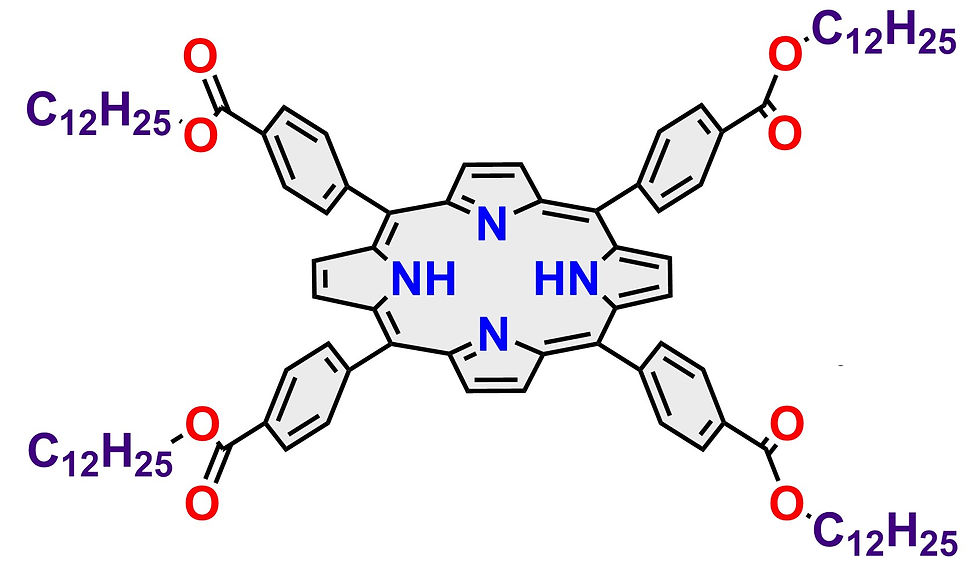
The copper–porphyrin introduced earlier bears alkyl chains with a carbon length of eleven. What happens, then, if the copper ion is removed from the porphyrin core and the alkyl chain length is increased to twelve carbons (lower left figure)? Interestingly, this porphyrin molecule also forms elastic crystals, but their properties differ markedly from those of the copper–porphyrin system. One notable feature is that the crystals grow to much larger sizes than those of the copper–porphyrin analogue [J. Am. Chem. Soc. 2025].
Molecular structure
Crystal bending

Moreover, these crystals exhibit an unusual thermal response: upon increasing the temperature, the crystal elongates—that is, it shows negative thermal expansion. Because most materials expand upon heating, this behaviour is highly uncommon. The figure below illustrates that when the temperature of the porphyrin crystal is lowered from 0 °C to −50 °C, the crystal elongates by approximately 3.5%. Importantly, this material can be obtained as high-quality single crystals, allowing precise determination of its molecular structure by single-crystal X-ray diffraction. Structural analysis reveals that the porphyrin molecules stack unidirectionally to form needle-like crystals, while two alkyl chains surrounding the core undergo pronounced thermal motion. Although the detailed mechanism is omitted here, we have clarified that increasing the temperature suppresses the thermal motion of the alkyl chains, which in turn alters the molecular packing and drives a phase transition to an elongated (expanded) crystal phase.
Negative thermal expansion

Temeperature-dependent structures

In this way, although the crystal undergoes elongation and contraction of up to approximately 3.5% in response to temperature changes—which is relatively large for comparable crystalline materials—the deformation is still too small to be easily observed with the naked eye.
To overcome this limitation, our group identified an extremely simple strategy to amplify this subtle crystal deformation into a much larger, visible motion: attaching a small weight to the crystal. The video on the left below (click to play) shows a weight (a small, round metal piece) affixed to the tip of the crystal with an adhesive, causing the crystal to bend under its own load as the temperature is varied. Upon cooling, the crystal bends significantly, and with further cooling it returns to a straight configuration. Importantly, this behaviour is fully reversible, and the same deformation is observed during the heating process as well.
Deformation by temperature change

Mechanism of deformation

When a load is applied to the crystal by attaching a weight, the crystal bends into an arc: the outer side of the arc is subjected to tensile strain, while the inner side experiences compressive strain. Upon cooling in this bent state, the outer side—where tensile stress is present—preferentially undergoes the transition to the elongated phase. In contrast, elongation on the inner side is suppressed because of the compressive stress. As a result, the difference in length between the outer and inner sides increases, causing the crystal to bend more strongly.
With further cooling, negative thermal expansion also induces elongation on the inner side of the arc. As the length difference between the two sides is reduced, the crystal straightens and returns to its original shape. This mechanism has been experimentally verified by pinpoint structural measurements using focused X-rays available at SPring-8.
Previously, we examined how a crystal bearing a small weight deforms when the surrounding temperature is changed uniformly. What happens, then, if this system is placed in an environment with a temperature gradient? The video shown at the bottom right (click to play) illustrates the behaviour of the crystal when a low-temperature heat source at 0 °C is positioned on the right-hand side of the crystal, while a high-temperature heat source at approximately 30 °C is placed near the lower left. Remarkably, the vibration of the crystal is amplified, giving rise to sustained, high-frequency oscillations with large deformation. Notably, no complex operations such as temperature modulation are applied in this experiment.
In other words, a static temperature difference is converted into mechanical motion in the form of crystal oscillation, meaning that the crystal–weight system operates as a thermal engine. To the best of our knowledge, this is the first demonstration of an organic crystal functioning as a thermal engine, and we refer to this new concept as a crystal thermal engine. The crystal thermal engine exhibits excellent durability, showing no signs of degradation even after 160 hours of continuous operation. Its operating principle is also straightforward: when the crystal is straight, it is cooled by the low-temperature heat source and bends; the bent crystal then reaches the high-temperature heat source, where it is warmed and straightens again. Repetition of this simple cycle drives the sustained oscillatory motion.


Although crystal thermal engines possess unique features—such as excellent durability and the ability to operate under mild temperature conditions—many challenges remain before practical implementation can be realised. For example, methods to precisely control the size and shape of the crystals have not yet been established. As a result, the operating speed and displacement vary significantly from one crystal thermal engine to another. In Sample 1 shown at the lower left (click to play), relatively slow motion is observed, whereas other crystal thermal engines exhibit much faster oscillations. These differences in dynamic behaviour are known to depend strongly on geometric and mechanical factors, including crystal thickness and length, as well as the mass of the attached weight. To enable practical use of crystal thermal engines, it will therefore be essential to organise these parameters into clear design guidelines and to establish strategies for actively controlling their operating characteristics.
In addition, the current system requires a low-temperature heat source of approximately 0 °C to operate, making it an important challenge to achieve operation under conditions closer to room temperature. Furthermore, the energy conversion efficiency of the present crystal thermal engines is estimated to be around 0.001%, and improving this efficiency represents another key research objective for future development.
Sample-dependent oscillation


We are currently exploring new materials that exhibit enhanced thermal-engine performance. Ultimately, our goal is to develop materials that can operate autonomously simply by being placed in a mild environment. Looking ahead, crystal thermal engines are expected to find broad applications, ranging from use as driving sources for miniature robots to power generation through the conversion of crystal motion into electrical energy.
Two-dimensional Nanosheets of Single-Molecule Magnets
Single-molecule magnets are compounds that, despite being individual molecules, possess a well-defined and stable magnetic orientation. Because information can be stored in a single molecule in the form of spin-up and spin-down states, they are regarded as promising candidates for ultra-high-density magnetic recording devices as well as for applications in spintronics. For the former application in particular, it is essential to form uniform, large-area two-dimensional arrays of single-molecule magnets, as individual molecules must be accessed with a nanoscale probe.
In contrast to top-down fabrication approaches based on micro- and nanofabrication of inorganic materials, device construction using molecules relies on bottom-up strategies that exploit self-assembly. Such approaches offer the potential to surpass top-down methods in terms of energy efficiency, miniaturisation, and structural uniformity. Against this background, I have successfully fabricated uniform, large-area thin films of single-molecule magnets by employing the Langmuir–Blodgett (LB) method, a representative bottom-up technique [J. Mater. Chem. C 2023]. The LB method is an energy-efficient, solution-based process. Film fabrication is highly straightforward: simply depositing a solution of single-molecule magnets bearing coordination sites onto an aqueous solution of metal ions induces coordination bond formation at the air–water interface, resulting in the spontaneous formation of a monolayer film.


After transferring the resulting thin films onto silicon substrates, we measured soft X-ray magnetic circular dichroism (XMCD) spectra at SPring-8. The measurements revealed pronounced perpendicular magnetic anisotropy, which is advantageous for magnetic recording media. This finding indicates a high degree of molecular orientation within the film. In contrast, films prepared by simply depositing a single-molecule-magnet solution onto pure water show no perpendicular magnetic anisotropy, demonstrating that coordination bond formation between the single-molecule magnets and metal ions is crucial for constructing highly oriented thin films. Furthermore, we have reported that chemical modification of the single-molecule magnets alters the molecular packing within the film and leads to enhanced magnetic properties [J. Mater. Chem. C 2024].
These results significantly advance bottom-up, molecule-based spintronics. Our current research aims to construct functional thin films in which single-molecule-magnet behaviour coexists with electrical conductivity, achieved through the formation of extended π-conjugated systems within the film.

Enhancing Single-Molecule Magnet Performance through Dimerisation
One of the major obstacles to the industrial application of single-molecule magnets is their limited ability to retain a fixed magnetic orientation over time. This limitation originates from the molecular nature of single-molecule magnets and the fact that their behaviour is governed by quantum mechanics. Even when a molecule is prepared in a spin-up state, it can spontaneously reverse to the spin-down state through quantum tunnelling of magnetisation. For applications as magnetic recording media, it is therefore essential to suppress this quantum tunnelling process.
We have demonstrated that this challenge can be effectively addressed by dimerising single-molecule magnets [Chem. Eur. J. 2018]. When potassium ions were introduced into single-molecule magnets functionalised with crown ether units, well-defined dimers were formed. Remarkably, the magnetic orientation lifetime of the dimer increased by a factor of 1000 compared with that of the monomer, indicating a dramatic enhancement of single-molecule-magnet performance. This improvement arises from magnetic interactions between the two coupled molecules in the dimer, which modify the spin wavefunction and suppress quantum tunnelling.
This work represents a rare and successful integration of host–guest chemistry with molecular magnetism, and clearly demonstrates that combining these two approaches is a powerful strategy for improving the performance of single-molecule magnets.

One of the major obstacles to the industrial application of single-molecule magnets is their limited ability to retain a fixed magnetic orientation over time. This limitation originates from the molecular nature of single-molecule magnets and the fact that their behaviour is governed by quantum mechanics. Even when a molecule is prepared in a spin-up state, it can spontaneously reverse to the spin-down state through quantum tunnelling of magnetisation. For applications as magnetic recording media, it is therefore essential to suppress this quantum tunnelling process.
We have demonstrated that this challenge can be effectively addressed by dimerising single-molecule magnets [Chem. Eur. J. 2018]. When potassium ions were introduced into single-molecule magnets functionalised with crown ether units, well-defined dimers were formed. Remarkably, the magnetic orientation lifetime of the dimer increased by a factor of 1000 compared with that of the monomer, indicating a dramatic enhancement of single-molecule-magnet performance. This improvement arises from magnetic interactions between the two coupled molecules in the dimer, which modify the spin wavefunction and suppress quantum tunnelling.
This work represents a rare and successful integration of host–guest chemistry with molecular magnetism, and clearly demonstrates that combining these two approaches is a powerful strategy for improving the performance of single-molecule magnets.